
Passive Suspension Demo
Download this examplePassiveSuspension.zipFull project — Dyad model + Julia + data
A car drives over a bumpy road, and its springs and dampers decide how much of the shaking reaches the person in the seat. This demo lets you tune those springs and dampers.
Three stacked masses carry the wheel, the car body, and the seated rider. They ride on an ISO 8608 Class C road profile — the standard description of an average-to-poor paved road. The profile is built here from 30 sine waves between 0.5 and 30 Hz, whose height grows with vehicle speed.
Ride quality is scored with ISO 2631-1, the standard that says how much vibration a seated person will tolerate. As shipped, the model falls short of the standard's top band; finding damper values that reach it is the point of the demo.
An actively controlled variant ships alongside as a reference.
The model
MyPassiveSuspension stacks three MassSpringDamper components — wheel, car and suspension, human and seat — on the Class C road source:
Running it
Run the 10 s passive transient and plot the seat response:
using PassiveSuspension, Plots

result = PassiveSuspensionTransient()
plot(result)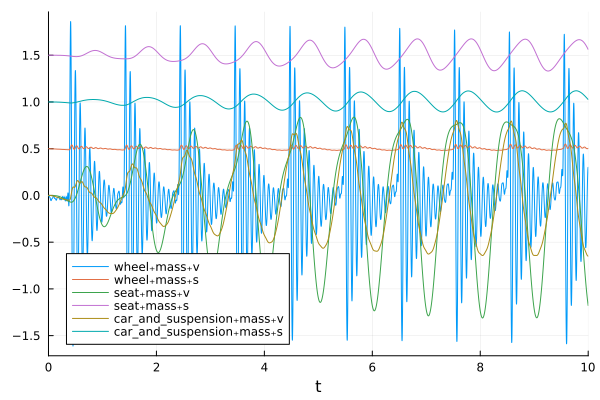
The actively controlled reference is ActiveSuspensionTransient(). It runs on its own input — a single smooth 0.2 m bump from the example library, repeating every 10 s — and on its own mass values.
The two runs therefore cover different roads and stand as separate reference points, not as a like-for-like pair.
Scoring comfort
The score is the ISO 2631-1 weighted RMS vertical acceleration at the seat. The standard's top band, "not uncomfortable", sits below 0.315 m/s²; tuning the dampers to get there is the target.