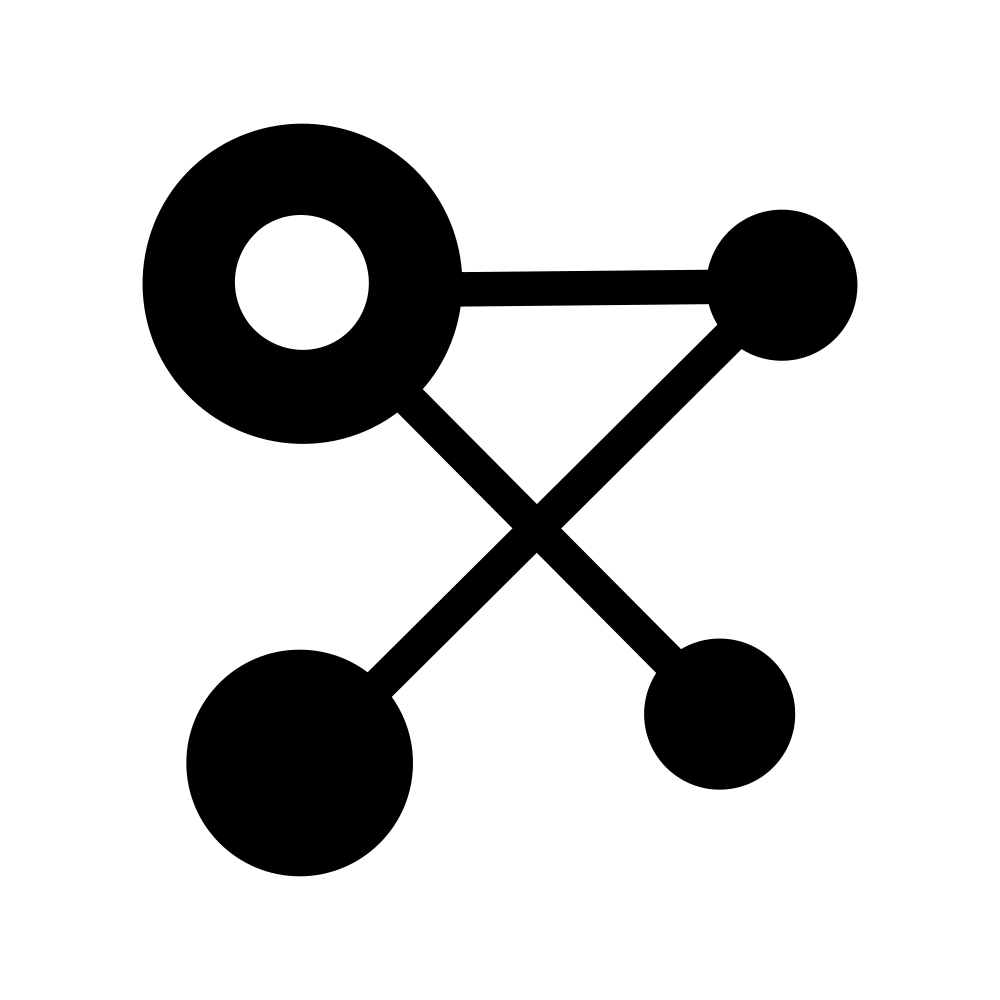

UniversalSpherical
Joint assembly: universal joint at frame_a + spherical joint at frame_b, connected by a fixed-length rigid rod. The rod's body-fixed frame is exposed via frame_ia so a rod mass / shape can be attached (connect(joint_us.frame_ia, body.frame_a)). Recommended for closed kinematic loops since the rotational kinematics of the assembly are solved symbolically.
Singular when n1_a is parallel to the rod direction rRod_ia. Choose n1_a orthogonal to the initial rod direction whenever possible.
n1_a: axis 1 of the universal joint, resolved inframe_a. Axis 2 is perpendicular ton1_aand to the rod and is computed automatically.rRod_ia: vector fromframe_aorigin toframe_borigin, resolved inframe_ia. Its norm sets the rod length.kinematic_constraint: when true, the rod-position equation uses the rotation-matrix-aware form preferred by the symbolic loop solver.
This component extends from PartialTwoFrames This component extends from Renderable
Usage
MultibodyComponents.UniversalSpherical(render=true, color=[0, 0.1, 1, 0.9], specular_coefficient=1.5, n1_a=[0, 0, 1], rRod_ia=[1, 0, 0], rod_radius=0.05, sphere_diameter=0.1, sphere_color=[1, 0.2, 1, 0.9], rod_length=norm_(rRod_ia), eRod_ia=rRod_ia / rod_length, e2_ia=cross(n1_a, eRod_ia), e3_ia=cross(eRod_ia, e2_ia))
Parameters:
| Name | Description | Units | Default value |
|---|---|---|---|
kinematic_constraint | – | true | |
constraint_residue_external | – | false | |
render | – | true | |
color | – | [0, 0.1, 1, 0.9] | |
specular_coefficient | – | 1.5 | |
n1_a | Axis 1 of the universal joint, resolved in frame_a | – | [0, 0, 1] |
rRod_ia | Vector from frame_a origin to frame_b origin, resolved in frame_ia | – | [1, 0, 0] |
rod_radius | Rendering radius of the rod cylinder | – | 0.05 |
sphere_diameter | Diameter of the sphere drawn at the spherical-joint end | – | 0.1 |
sphere_color | RGBA color of the sphere drawn at the spherical-joint end | – | [1, 0.2, 1, 0.9] |
Connectors
frame_a- Frame3D is the fundamental 3D connector used for 6DOF motion. Most components have one or severalFrame
connectors that can be connected together (Frame3D)
frame_b- Frame3D is the fundamental 3D connector used for 6DOF motion. Most components have one or severalFrame
connectors that can be connected together (Frame3D)
frame_ia- Frame3D is the fundamental 3D connector used for 6DOF motion. Most components have one or severalFrame
connectors that can be connected together (Frame3D)
Variables
| Name | Description | Units |
|---|---|---|
f_rod | Constraint force along the rod (positive on frame_a, directed a → b) | – |
rRod_0 | Position vector frame_a → frame_b, resolved in world | m |
rRod_a | Position vector frame_a → frame_b, resolved in frame_a | m |
eRod_a | Unit vector along the rod, resolved in frame_a | – |
n2_a | n1_a × eRod_a (axis 2 of the universal joint), resolved in frame_a | – |
length2_n2_a | Squared length of n2_a | – |
length_n2_a | Length of n2_a | – |
e2_a | Unit vector along axis 2 of the universal joint, resolved in frame_a | – |
e3_a | Unit vector perpendicular to eRod_a and e2_a, resolved in frame_a | – |
der_rRod_a_L | der(rRod_a) / rod_length | – |
w_rel_ia1 | Angular velocity of intermediate frame ia1 wrt frame_a, in ia1 basis | – |
f_b_a1 | frame_b.f resolved in frame_a, without the f_rod component | – |
f_b_a | frame_b.f resolved in frame_a | – |
f_ia_a | frame_ia.f resolved in frame_a | – |
t_ia_a | frame_ia.tau resolved in frame_a | – |
constraint_residue | Constraint residue: length constraint by default, or rod force when external | – |
Behavior
Source
"""
Joint assembly: universal joint at `frame_a` + spherical joint at `frame_b`,
connected by a fixed-length rigid rod. The rod's body-fixed frame is exposed
via `frame_ia` so a rod mass / shape can be attached
(`connect(joint_us.frame_ia, body.frame_a)`). Recommended for closed
kinematic loops since the rotational kinematics of the assembly are solved
symbolically.

Singular when `n1_a` is parallel to the rod direction `rRod_ia`. Choose
`n1_a` orthogonal to the initial rod direction whenever possible.

- `n1_a`: axis 1 of the universal joint, resolved in `frame_a`. Axis 2 is
  perpendicular to `n1_a` and to the rod and is computed automatically.
- `rRod_ia`: vector from `frame_a` origin to `frame_b` origin, resolved in
  `frame_ia`. Its norm sets the rod length.
- `kinematic_constraint`: when true, the rod-position equation uses the
  rotation-matrix-aware form preferred by the symbolic loop solver.
"""
component UniversalSpherical
  extends PartialTwoFrames()
  extends Renderable(color = [0, 0.1, 1, 0.9])
  frame_ia = Frame3D() {
    "Dyad": {
      "placement": {
        "diagram": {"iconName": "default", "x1": 400, "y1": 450, "x2": 500, "y2": 550, "rot": 0}
      },
      "tags": []
    }
  }
  rod_shape = CylinderShape(render = render, color = color, r = frame_a.r_0, R = transpose(frame_a.R), length_direction = eRod_a, length = rod_length, width = 2 * rod_radius, height = 2 * rod_radius) {
    "Dyad": {
      "placement": {
        "diagram": {"iconName": "default", "x1": 570, "y1": 690, "x2": 670, "y2": 790, "rot": 0}
      },
      "tags": []
    }
  }
  sphere_shape = SphereShape(render = render, color = sphere_color, r = frame_b.r_0, R = transpose(frame_b.R), length = sphere_diameter, width = sphere_diameter, height = sphere_diameter) {
    "Dyad": {
      "placement": {
        "diagram": {"iconName": "default", "x1": 440, "y1": 640, "x2": 540, "y2": 740, "rot": 0}
      },
      "tags": []
    }
  }
  structural parameter kinematic_constraint::Boolean = true
  structural parameter constraint_residue_external::Boolean = false
  "Axis 1 of the universal joint, resolved in frame_a"
  parameter n1_a::Real[3] = [0, 0, 1]
  "Vector from frame_a origin to frame_b origin, resolved in frame_ia"
  parameter rRod_ia::Real[3] = [1, 0, 0]
  "Rendering radius of the rod cylinder"
  parameter rod_radius::Real = 0.05
  "Diameter of the sphere drawn at the spherical-joint end"
  parameter sphere_diameter::Real = 0.1
  "RGBA color of the sphere drawn at the spherical-joint end"
  parameter sphere_color::Real[4] = [1, 0.2, 1, 0.9]
  final parameter rod_length::Real = norm_(rRod_ia)
  final parameter eRod_ia::Real[3] = rRod_ia / rod_length
  final parameter e2_ia::Real[3] = cross(n1_a, eRod_ia)
  final parameter e3_ia::Real[3] = cross(eRod_ia, e2_ia)
  "Constraint force along the rod (positive on frame_a, directed a → b)"
  variable f_rod::Real
  "Position vector frame_a → frame_b, resolved in world"
  variable rRod_0::Position[3]
  "Position vector frame_a → frame_b, resolved in frame_a"
  variable rRod_a::Position[3]
  "Unit vector along the rod, resolved in frame_a"
  variable eRod_a::Real[3]
  "n1_a × eRod_a (axis 2 of the universal joint), resolved in frame_a"
  variable n2_a::Real[3]
  "Squared length of n2_a"
  variable length2_n2_a::Real
  "Length of n2_a"
  variable length_n2_a::Real
  "Unit vector along axis 2 of the universal joint, resolved in frame_a"
  variable e2_a::Real[3]
  "Unit vector perpendicular to eRod_a and e2_a, resolved in frame_a"
  variable e3_a::Real[3]
  "der(rRod_a) / rod_length"
  variable der_rRod_a_L::Real[3]
  "Angular velocity of intermediate frame ia1 wrt frame_a, in ia1 basis"
  variable w_rel_ia1::Real[3]
  "frame_b.f resolved in frame_a, without the f_rod component"
  variable f_b_a1::Real[3]
  "frame_b.f resolved in frame_a"
  variable f_b_a::Real[3]
  "frame_ia.f resolved in frame_a"
  variable f_ia_a::Real[3]
  "frame_ia.tau resolved in frame_a"
  variable t_ia_a::Real[3]
  "Constraint residue: length constraint by default, or rod force when external"
  variable constraint_residue::Real
relations
  # Guesses keep initialization away from the degenerate zero-length rod
  # configuration (where eRod_a / e2_a become 0/0); mirror Multibody.jl.
  guess rRod_0 = rRod_ia
  guess rRod_a = rRod_ia
  guess length2_n2_a = 1
  guess constraint_residue = 0
  if kinematic_constraint
    rRod_0 = transpose(frame_b.R) * (frame_b.R * frame_b.r_0) - transpose(frame_a.R) * (frame_a.R * frame_a.r_0)
  else
    rRod_0 = frame_b.r_0 - frame_a.r_0
  end
  rRod_a = resolve2(frame_a.R, rRod_0)
  eRod_a = rRod_a / rod_length
  n2_a = cross(n1_a, eRod_a)
  length2_n2_a = dot(n2_a, n2_a)
  assert(length2_n2_a > 1e-10, "A UniversalSpherical joint is in the singular configuration of the universal joint.")
  length_n2_a = sqrt(length2_n2_a)
  e2_a = n2_a / length_n2_a
  e3_a = cross(eRod_a, e2_a)
  # constraint_residue is pinned to 0. When constraint_residue_external is false
  # the length constraint below provides the second equation. When true, the
  # parent assembly (e.g. JointUSR) supplies `constraint_residue = f_rod - <rod force>`
  # instead, so the kinematic loop is solved analytically.
  constraint_residue = 0
  if !constraint_residue_external
    constraint_residue = dot(rRod_0, rRod_0) - rod_length ^ 2
  end
  der_rRod_a_L = (resolve2(frame_a.R, der(rRod_0)) - cross(angular_velocity2(ori(frame_a)), rRod_a)) / rod_length
  w_rel_ia1 = [dot(e3_a, cross(n1_a, der_rRod_a_L)) / length_n2_a, -dot(e3_a, der_rRod_a_L), dot(e2_a, der_rRod_a_L)]
  frame_ia.r_0 = frame_a.r_0
  RotationMatrix(frame_ia.R) = absolute_rotation(frame_a, R_rel_ia_from(eRod_a, e2_a, e3_a, eRod_ia, e2_ia, e3_ia, w_rel_ia1))
  f_ia_a = resolve1(R_rel_ia_from(eRod_a, e2_a, e3_a, eRod_ia, e2_ia, e3_ia, w_rel_ia1), frame_ia.f)
  t_ia_a = resolve1(R_rel_ia_from(eRod_a, e2_a, e3_a, eRod_ia, e2_ia, e3_ia, w_rel_ia1), frame_ia.tau)
  f_b_a1 = -e2_a * (dot(n1_a, t_ia_a) / (rod_length * dot(n1_a, e3_a))) + e3_a * (dot(e2_a, t_ia_a) / rod_length)
  f_b_a = -f_rod * eRod_a + f_b_a1
  frame_b.f = resolve_relative(f_b_a, frame_a.R, frame_b.R)
  frame_b.tau = [0, 0, 0]
  [0, 0, 0] = frame_a.f + f_b_a + f_ia_a
  [0, 0, 0] = frame_a.tau + t_ia_a + cross(rRod_a, f_b_a)
metadata {
  "Dyad": {
    "icons": {"default": "dyad://MultibodyComponents/UniversalSpherical.svg"},
    "labels": [
      {
        "label": "$(instance)",
        "x": 500,
        "y": 200,
        "rot": 0,
        "attrs": {"font-size": "160"}
      }
    ]
  }
}
end
Flattened Source
"""
Joint assembly: universal joint at `frame_a` + spherical joint at `frame_b`,
connected by a fixed-length rigid rod. The rod's body-fixed frame is exposed
via `frame_ia` so a rod mass / shape can be attached
(`connect(joint_us.frame_ia, body.frame_a)`). Recommended for closed
kinematic loops since the rotational kinematics of the assembly are solved
symbolically.

Singular when `n1_a` is parallel to the rod direction `rRod_ia`. Choose
`n1_a` orthogonal to the initial rod direction whenever possible.

- `n1_a`: axis 1 of the universal joint, resolved in `frame_a`. Axis 2 is
  perpendicular to `n1_a` and to the rod and is computed automatically.
- `rRod_ia`: vector from `frame_a` origin to `frame_b` origin, resolved in
  `frame_ia`. Its norm sets the rod length.
- `kinematic_constraint`: when true, the rod-position equation uses the
  rotation-matrix-aware form preferred by the symbolic loop solver.
"""
component UniversalSpherical
  frame_a = Frame3D() {
    "Dyad": {
      "placement": {
        "diagram": {"iconName": "default", "x1": -50, "y1": 450, "x2": 50, "y2": 550, "rot": 0}
      },
      "tags": []
    }
  }
  frame_b = Frame3D() {
    "Dyad": {
      "placement": {
        "diagram": {"iconName": "default", "x1": 950, "y1": 450, "x2": 1050, "y2": 550, "rot": 0}
      },
      "tags": []
    }
  }
  parameter render::Boolean = true
  parameter color::Real[4] = [0.5, 0.5, 0.5, 1.0]
  parameter specular_coefficient::Real = 1.5
  frame_ia = Frame3D() {
    "Dyad": {
      "placement": {
        "diagram": {"iconName": "default", "x1": 400, "y1": 450, "x2": 500, "y2": 550, "rot": 0}
      },
      "tags": []
    }
  }
  rod_shape = CylinderShape(render = render, color = color, r = frame_a.r_0, R = transpose(frame_a.R), length_direction = eRod_a, length = rod_length, width = 2 * rod_radius, height = 2 * rod_radius) {
    "Dyad": {
      "placement": {
        "diagram": {"iconName": "default", "x1": 570, "y1": 690, "x2": 670, "y2": 790, "rot": 0}
      },
      "tags": []
    }
  }
  sphere_shape = SphereShape(render = render, color = sphere_color, r = frame_b.r_0, R = transpose(frame_b.R), length = sphere_diameter, width = sphere_diameter, height = sphere_diameter) {
    "Dyad": {
      "placement": {
        "diagram": {"iconName": "default", "x1": 440, "y1": 640, "x2": 540, "y2": 740, "rot": 0}
      },
      "tags": []
    }
  }
  structural parameter kinematic_constraint::Boolean = true
  structural parameter constraint_residue_external::Boolean = false
  "Axis 1 of the universal joint, resolved in frame_a"
  parameter n1_a::Real[3] = [0, 0, 1]
  "Vector from frame_a origin to frame_b origin, resolved in frame_ia"
  parameter rRod_ia::Real[3] = [1, 0, 0]
  "Rendering radius of the rod cylinder"
  parameter rod_radius::Real = 0.05
  "Diameter of the sphere drawn at the spherical-joint end"
  parameter sphere_diameter::Real = 0.1
  "RGBA color of the sphere drawn at the spherical-joint end"
  parameter sphere_color::Real[4] = [1, 0.2, 1, 0.9]
  final parameter rod_length::Real = norm_(rRod_ia)
  final parameter eRod_ia::Real[3] = rRod_ia / rod_length
  final parameter e2_ia::Real[3] = cross(n1_a, eRod_ia)
  final parameter e3_ia::Real[3] = cross(eRod_ia, e2_ia)
  "Constraint force along the rod (positive on frame_a, directed a → b)"
  variable f_rod::Real
  "Position vector frame_a → frame_b, resolved in world"
  variable rRod_0::Position[3]
  "Position vector frame_a → frame_b, resolved in frame_a"
  variable rRod_a::Position[3]
  "Unit vector along the rod, resolved in frame_a"
  variable eRod_a::Real[3]
  "n1_a × eRod_a (axis 2 of the universal joint), resolved in frame_a"
  variable n2_a::Real[3]
  "Squared length of n2_a"
  variable length2_n2_a::Real
  "Length of n2_a"
  variable length_n2_a::Real
  "Unit vector along axis 2 of the universal joint, resolved in frame_a"
  variable e2_a::Real[3]
  "Unit vector perpendicular to eRod_a and e2_a, resolved in frame_a"
  variable e3_a::Real[3]
  "der(rRod_a) / rod_length"
  variable der_rRod_a_L::Real[3]
  "Angular velocity of intermediate frame ia1 wrt frame_a, in ia1 basis"
  variable w_rel_ia1::Real[3]
  "frame_b.f resolved in frame_a, without the f_rod component"
  variable f_b_a1::Real[3]
  "frame_b.f resolved in frame_a"
  variable f_b_a::Real[3]
  "frame_ia.f resolved in frame_a"
  variable f_ia_a::Real[3]
  "frame_ia.tau resolved in frame_a"
  variable t_ia_a::Real[3]
  "Constraint residue: length constraint by default, or rod force when external"
  variable constraint_residue::Real
relations
  # Guesses keep initialization away from the degenerate zero-length rod
  # configuration (where eRod_a / e2_a become 0/0); mirror Multibody.jl.
  guess rRod_0 = rRod_ia
  guess rRod_a = rRod_ia
  guess length2_n2_a = 1
  guess constraint_residue = 0
  if kinematic_constraint
    rRod_0 = transpose(frame_b.R) * (frame_b.R * frame_b.r_0) - transpose(frame_a.R) * (frame_a.R * frame_a.r_0)
  else
    rRod_0 = frame_b.r_0 - frame_a.r_0
  end
  rRod_a = resolve2(frame_a.R, rRod_0)
  eRod_a = rRod_a / rod_length
  n2_a = cross(n1_a, eRod_a)
  length2_n2_a = dot(n2_a, n2_a)
  assert(length2_n2_a > 1e-10, "A UniversalSpherical joint is in the singular configuration of the universal joint.")
  length_n2_a = sqrt(length2_n2_a)
  e2_a = n2_a / length_n2_a
  e3_a = cross(eRod_a, e2_a)
  # constraint_residue is pinned to 0. When constraint_residue_external is false
  # the length constraint below provides the second equation. When true, the
  # parent assembly (e.g. JointUSR) supplies `constraint_residue = f_rod - <rod force>`
  # instead, so the kinematic loop is solved analytically.
  constraint_residue = 0
  if !constraint_residue_external
    constraint_residue = dot(rRod_0, rRod_0) - rod_length ^ 2
  end
  der_rRod_a_L = (resolve2(frame_a.R, der(rRod_0)) - cross(angular_velocity2(ori(frame_a)), rRod_a)) / rod_length
  w_rel_ia1 = [dot(e3_a, cross(n1_a, der_rRod_a_L)) / length_n2_a, -dot(e3_a, der_rRod_a_L), dot(e2_a, der_rRod_a_L)]
  frame_ia.r_0 = frame_a.r_0
  RotationMatrix(frame_ia.R) = absolute_rotation(frame_a, R_rel_ia_from(eRod_a, e2_a, e3_a, eRod_ia, e2_ia, e3_ia, w_rel_ia1))
  f_ia_a = resolve1(R_rel_ia_from(eRod_a, e2_a, e3_a, eRod_ia, e2_ia, e3_ia, w_rel_ia1), frame_ia.f)
  t_ia_a = resolve1(R_rel_ia_from(eRod_a, e2_a, e3_a, eRod_ia, e2_ia, e3_ia, w_rel_ia1), frame_ia.tau)
  f_b_a1 = -e2_a * (dot(n1_a, t_ia_a) / (rod_length * dot(n1_a, e3_a))) + e3_a * (dot(e2_a, t_ia_a) / rod_length)
  f_b_a = -f_rod * eRod_a + f_b_a1
  frame_b.f = resolve_relative(f_b_a, frame_a.R, frame_b.R)
  frame_b.tau = [0, 0, 0]
  [0, 0, 0] = frame_a.f + f_b_a + f_ia_a
  [0, 0, 0] = frame_a.tau + t_ia_a + cross(rRod_a, f_b_a)
metadata {
  "Dyad": {
    "icons": {"default": "dyad://MultibodyComponents/UniversalSpherical.svg"},
    "labels": [
      {
        "label": "$(instance)",
        "x": 500,
        "y": 200,
        "rot": 0,
        "attrs": {"font-size": "160"}
      }
    ]
  }
}
end
Test Cases
No test cases defined.
Related
Examples
Experiments
Analyses