LIBRARY

Examples.InitialConditions
Setting of initial conditions.
Replicates the structure of Modelica.Mechanics.Translational.Examples.InitialConditions.
Two systems demonstrate different ways of specifying initial conditions.
Top system: A chain fixed2 → s2 (spring) → m3 (mass) → sd2 (spring-damper) → m4 (mass) with positions chosen so the system starts at rest: m3.s = fixed2.s0 + s2.s_rel0 + m3.L/2 = 1 + 2 + 1.5 = 4.5 m m4.s = 4.5 + 1.5 + 4 + 2.5 = 12.5 m
Bottom system: A chain fixed1 → s1 (spring) → m1 (mass) → sd1 (spring-damper) → m2 (mass) with spring s1 starting compressed (s_rel=0.5 vs s_rel0=1), so the system is not at rest.
Usage
TranslationalComponents.Examples.InitialConditions()
Behavior
Source
dyad
"""
Setting of initial conditions.

Replicates the structure of Modelica.Mechanics.Translational.Examples.InitialConditions.

Two systems demonstrate different ways of specifying initial conditions.

**Top system:** A chain fixed2 → s2 (spring) → m3 (mass) → sd2 (spring-damper) → m4 (mass)
with positions chosen so the system starts at rest:
  m3.s = fixed2.s0 + s2.s_rel0 + m3.L/2 = 1 + 2 + 1.5 = 4.5 m
  m4.s = 4.5 + 1.5 + 4 + 2.5 = 12.5 m

**Bottom system:** A chain fixed1 → s1 (spring) → m1 (mass) → sd1 (spring-damper) → m2 (mass)
with spring s1 starting compressed (s_rel=0.5 vs s_rel0=1), so the system
is not at rest.
"""
example component InitialConditions
  "Fixed reference at s=1 (top system)"
  fixed2 = TranslationalComponents.Components.Fixed(s0 = 1) {
    "Dyad": {"placement": {"diagram": {"x1": 20, "x2": 120, "y1": 125, "y2": 225}}}
  }
  "Spring s2 with unstretched length 2 m (top system)"
  s2 = TranslationalComponents.Components.Spring(s_rel0 = 2, c = 1e3) {
    "Dyad": {"placement": {"diagram": {"x1": 145, "x2": 245, "y1": 20, "y2": 120}}}
  }
  "Mass m3 with L=3, starting at rest at s=4.5 (top system)"
  m3 = TranslationalComponents.Components.Mass(L = 3, m = 1, s(initial = 4.5), v(initial = 0)) {
    "Dyad": {"placement": {"diagram": {"x1": 275, "x2": 375, "y1": 20, "y2": 120}}}
  }
  "Spring-damper sd2 with unstretched length 4 m (top system)"
  sd2 = TranslationalComponents.Components.SpringDamper(s_rel0 = 4, c = 111, d = 1) {
    "Dyad": {"placement": {"diagram": {"x1": 405, "x2": 505, "y1": 20, "y2": 120}}}
  }
  "Mass m4 with L=5, starting at rest at s=12.5 (top system)"
  m4 = TranslationalComponents.Components.Mass(L = 5, m = 1, s(initial = 12.5), v(initial = 0)) {
    "Dyad": {"placement": {"diagram": {"x1": 535, "x2": 635, "y1": 20, "y2": 120}}}
  }
  "Fixed reference at s=-1 (bottom system)"
  fixed1 = TranslationalComponents.Components.Fixed(s0 = -1) {
    "Dyad": {"placement": {"diagram": {"x1": 20, "x2": 120, "y1": 350, "y2": 450}}}
  }
  "Spring s1 with unstretched length 1 m, starting compressed (bottom system)"
  s1 = TranslationalComponents.Components.Spring(s_rel0 = 1, c = 1e3, s_rel(initial = 0.5)) {
    "Dyad": {"placement": {"diagram": {"x1": 145, "x2": 245, "y1": 245, "y2": 345}}}
  }
  "Mass m1 with L=1, starting with v=0 (bottom system)"
  m1 = TranslationalComponents.Components.Mass(L = 1, m = 1, v(initial = 0)) {
    "Dyad": {"placement": {"diagram": {"x1": 275, "x2": 375, "y1": 245, "y2": 345}}}
  }
  "Spring-damper sd1 (bottom system)"
  sd1 = TranslationalComponents.Components.SpringDamper(s_rel0 = 1, c = 111, d = 1, s_rel(initial = 1), v_rel(initial = 0)) {
    "Dyad": {"placement": {"diagram": {"x1": 405, "x2": 505, "y1": 245, "y2": 345}}}
  }
  "Mass m2 with L=2 (bottom system)"
  m2 = TranslationalComponents.Components.Mass(L = 2, m = 1) {
    "Dyad": {"placement": {"diagram": {"x1": 540, "x2": 640, "y1": 250, "y2": 350}}}
  }
relations
  # Top system connections
  connect(s2.flange_a, fixed2.flange) {"Dyad": {"edges": [{"S": 1, "M": [{"x": 70, "y": 70}], "E": 2}]}}
  connect(m3.flange_a, s2.flange_b) {"Dyad": {"edges": [{"S": 1, "M": [], "E": 2}]}}
  connect(sd2.flange_a, m3.flange_b) {"Dyad": {"edges": [{"S": 1, "M": [], "E": 2}]}}
  connect(m4.flange_a, sd2.flange_b) {"Dyad": {"edges": [{"S": 1, "M": [], "E": 2}]}}
  # Bottom system connections
  connect(s1.flange_a, fixed1.flange) {"Dyad": {"edges": [{"S": 1, "M": [{"x": 70, "y": 295}], "E": 2}]}}
  connect(m1.flange_a, s1.flange_b) {"Dyad": {"edges": [{"S": 1, "M": [], "E": 2}]}}
  connect(sd1.flange_a, m1.flange_b) {"Dyad": {"edges": [{"S": 1, "M": [], "E": 2}]}}
  connect(m2.flange_a, sd1.flange_b) {
    "Dyad": {"edges": [{"S": 1, "M": [{"x": 520, "y": 300}, {"x": 520, "y": 295}], "E": 2}]}
  }
metadata {
  "Dyad": {
    "icons": {"default": "dyad://TranslationalComponents/Example.svg"},
    "tests": {
      "case1": {
        "stop": 5,
        "atol": {
          "m1.s": 0.01,
          "m1.v": 0.01,
          "m3.s": 0.001,
          "m3.v": 0.001,
          "m4.s": 0.001,
          "m4.v": 0.001,
          "sd1.s_rel": 0.01,
          "sd1.v_rel": 0.01
        },
        "expect": {
          "final": {"m3.s": 4.5, "m3.v": 0, "m4.s": 12.5, "m4.v": 0},
          "signals": [
            "m1.s",
            "m1.v",
            "m3.s",
            "m3.v",
            "m4.s",
            "m4.v",
            "sd1.s_rel",
            "sd1.v_rel",
            "sd2.s_rel",
            "sd2.v_rel"
          ]
        }
      }
    }
  }
}
end
Flattened Source
dyad
"""
Setting of initial conditions.

Replicates the structure of Modelica.Mechanics.Translational.Examples.InitialConditions.

Two systems demonstrate different ways of specifying initial conditions.

**Top system:** A chain fixed2 → s2 (spring) → m3 (mass) → sd2 (spring-damper) → m4 (mass)
with positions chosen so the system starts at rest:
  m3.s = fixed2.s0 + s2.s_rel0 + m3.L/2 = 1 + 2 + 1.5 = 4.5 m
  m4.s = 4.5 + 1.5 + 4 + 2.5 = 12.5 m

**Bottom system:** A chain fixed1 → s1 (spring) → m1 (mass) → sd1 (spring-damper) → m2 (mass)
with spring s1 starting compressed (s_rel=0.5 vs s_rel0=1), so the system
is not at rest.
"""
example component InitialConditions
  "Fixed reference at s=1 (top system)"
  fixed2 = TranslationalComponents.Components.Fixed(s0 = 1) {
    "Dyad": {"placement": {"diagram": {"x1": 20, "x2": 120, "y1": 125, "y2": 225}}}
  }
  "Spring s2 with unstretched length 2 m (top system)"
  s2 = TranslationalComponents.Components.Spring(s_rel0 = 2, c = 1e3) {
    "Dyad": {"placement": {"diagram": {"x1": 145, "x2": 245, "y1": 20, "y2": 120}}}
  }
  "Mass m3 with L=3, starting at rest at s=4.5 (top system)"
  m3 = TranslationalComponents.Components.Mass(L = 3, m = 1, s(initial = 4.5), v(initial = 0)) {
    "Dyad": {"placement": {"diagram": {"x1": 275, "x2": 375, "y1": 20, "y2": 120}}}
  }
  "Spring-damper sd2 with unstretched length 4 m (top system)"
  sd2 = TranslationalComponents.Components.SpringDamper(s_rel0 = 4, c = 111, d = 1) {
    "Dyad": {"placement": {"diagram": {"x1": 405, "x2": 505, "y1": 20, "y2": 120}}}
  }
  "Mass m4 with L=5, starting at rest at s=12.5 (top system)"
  m4 = TranslationalComponents.Components.Mass(L = 5, m = 1, s(initial = 12.5), v(initial = 0)) {
    "Dyad": {"placement": {"diagram": {"x1": 535, "x2": 635, "y1": 20, "y2": 120}}}
  }
  "Fixed reference at s=-1 (bottom system)"
  fixed1 = TranslationalComponents.Components.Fixed(s0 = -1) {
    "Dyad": {"placement": {"diagram": {"x1": 20, "x2": 120, "y1": 350, "y2": 450}}}
  }
  "Spring s1 with unstretched length 1 m, starting compressed (bottom system)"
  s1 = TranslationalComponents.Components.Spring(s_rel0 = 1, c = 1e3, s_rel(initial = 0.5)) {
    "Dyad": {"placement": {"diagram": {"x1": 145, "x2": 245, "y1": 245, "y2": 345}}}
  }
  "Mass m1 with L=1, starting with v=0 (bottom system)"
  m1 = TranslationalComponents.Components.Mass(L = 1, m = 1, v(initial = 0)) {
    "Dyad": {"placement": {"diagram": {"x1": 275, "x2": 375, "y1": 245, "y2": 345}}}
  }
  "Spring-damper sd1 (bottom system)"
  sd1 = TranslationalComponents.Components.SpringDamper(s_rel0 = 1, c = 111, d = 1, s_rel(initial = 1), v_rel(initial = 0)) {
    "Dyad": {"placement": {"diagram": {"x1": 405, "x2": 505, "y1": 245, "y2": 345}}}
  }
  "Mass m2 with L=2 (bottom system)"
  m2 = TranslationalComponents.Components.Mass(L = 2, m = 1) {
    "Dyad": {"placement": {"diagram": {"x1": 540, "x2": 640, "y1": 250, "y2": 350}}}
  }
relations
  # Top system connections
  connect(s2.flange_a, fixed2.flange) {"Dyad": {"edges": [{"S": 1, "M": [{"x": 70, "y": 70}], "E": 2}]}}
  connect(m3.flange_a, s2.flange_b) {"Dyad": {"edges": [{"S": 1, "M": [], "E": 2}]}}
  connect(sd2.flange_a, m3.flange_b) {"Dyad": {"edges": [{"S": 1, "M": [], "E": 2}]}}
  connect(m4.flange_a, sd2.flange_b) {"Dyad": {"edges": [{"S": 1, "M": [], "E": 2}]}}
  # Bottom system connections
  connect(s1.flange_a, fixed1.flange) {"Dyad": {"edges": [{"S": 1, "M": [{"x": 70, "y": 295}], "E": 2}]}}
  connect(m1.flange_a, s1.flange_b) {"Dyad": {"edges": [{"S": 1, "M": [], "E": 2}]}}
  connect(sd1.flange_a, m1.flange_b) {"Dyad": {"edges": [{"S": 1, "M": [], "E": 2}]}}
  connect(m2.flange_a, sd1.flange_b) {
    "Dyad": {"edges": [{"S": 1, "M": [{"x": 520, "y": 300}, {"x": 520, "y": 295}], "E": 2}]}
  }
metadata {
  "Dyad": {
    "icons": {"default": "dyad://TranslationalComponents/Example.svg"},
    "tests": {
      "case1": {
        "stop": 5,
        "atol": {
          "m1.s": 0.01,
          "m1.v": 0.01,
          "m3.s": 0.001,
          "m3.v": 0.001,
          "m4.s": 0.001,
          "m4.v": 0.001,
          "sd1.s_rel": 0.01,
          "sd1.v_rel": 0.01
        },
        "expect": {
          "final": {"m3.s": 4.5, "m3.v": 0, "m4.s": 12.5, "m4.v": 0},
          "signals": [
            "m1.s",
            "m1.v",
            "m3.s",
            "m3.v",
            "m4.s",
            "m4.v",
            "sd1.s_rel",
            "sd1.v_rel",
            "sd2.s_rel",
            "sd2.v_rel"
          ]
        }
      }
    }
  }
}
end
Test Cases
Test Case case1
julia
plt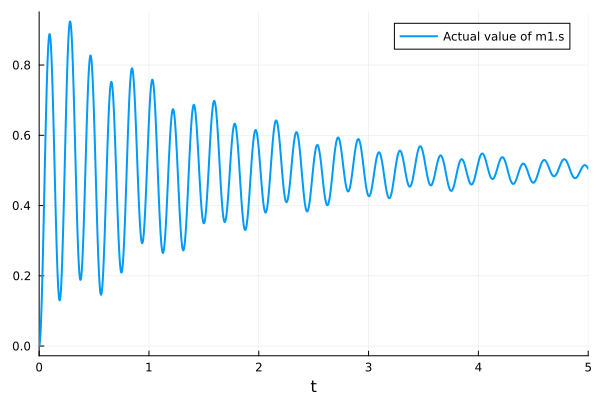
julia
plt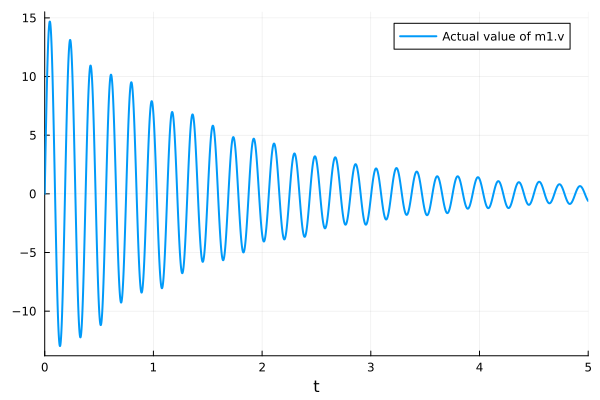
julia
plt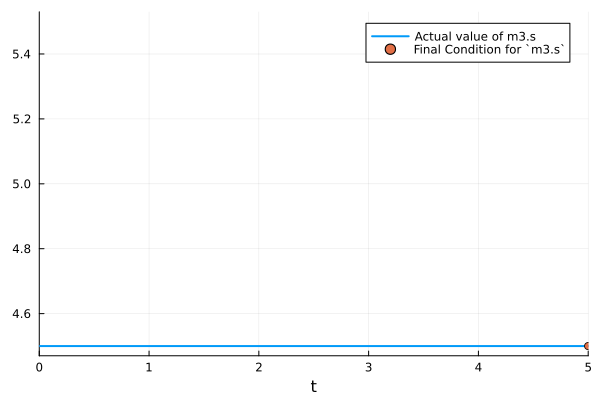
julia
plt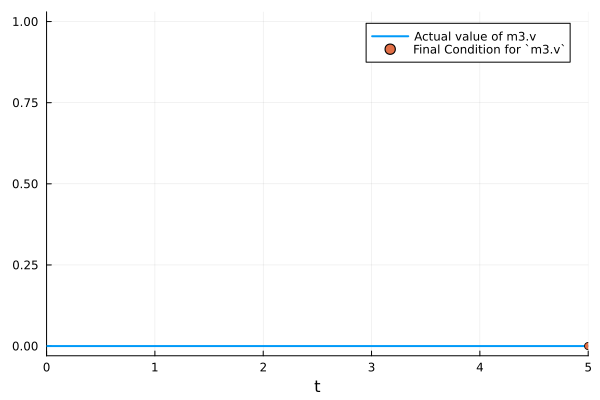
julia
plt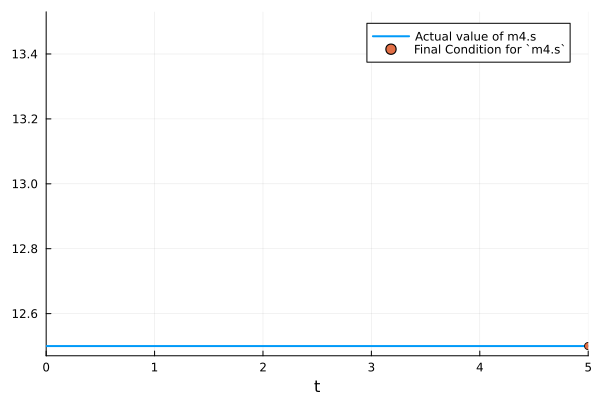
julia
plt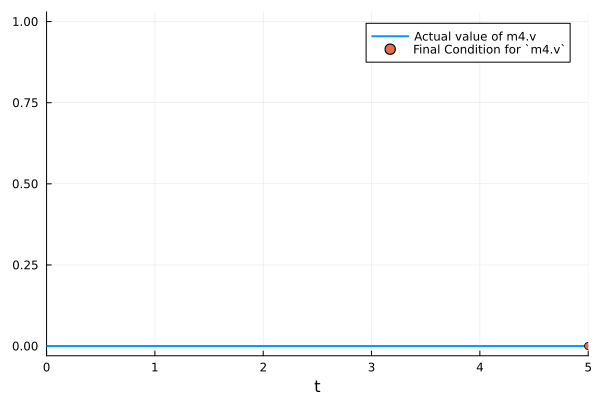
julia
plt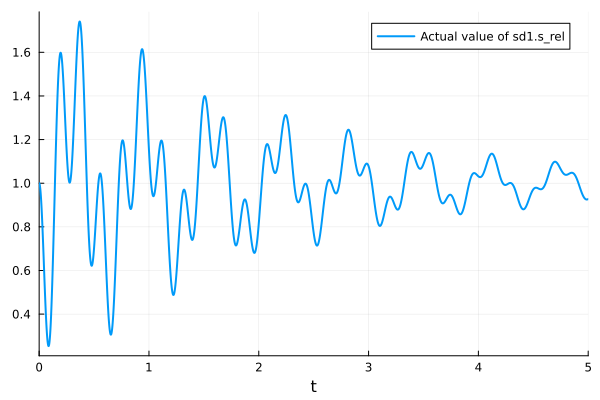
julia
plt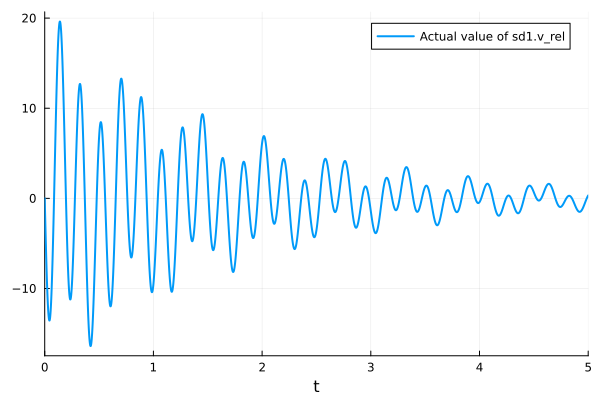
julia
plt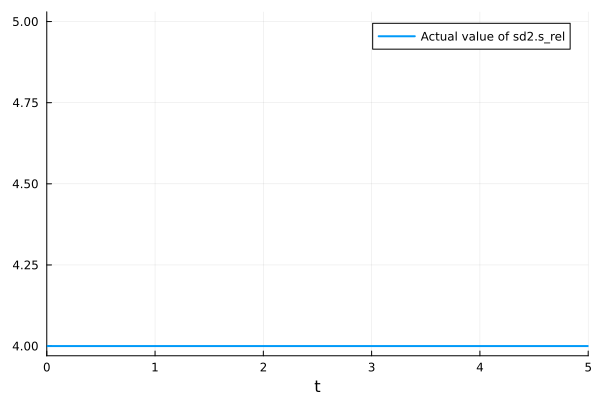
julia
plt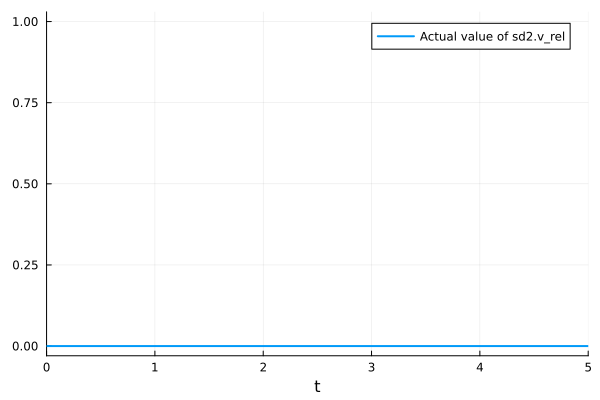
Related
Examples
Experiments
Analyses