
Analog.Examples.ParallelResonance
ParallelResonance models two parallel RLC resonance circuits, each driven by a current source with variable frequency and amplitude.
This component simulates two independent parallel RLC circuits. The first circuit is driven by a sinusoidal current source, and the second by a cosinusoidal current source. The frequency of both current sources is controlled by a common ramp signal, causing a frequency sweep. The amplitude of both current sources is determined by a common constant signal. Each RLC circuit consists of a resistor, an inductor, and a capacitor connected in parallel with the current source and a voltage sensor. The ground components provide a common reference potential.
Usage
ElectricalComponents.Analog.Examples.ParallelResonance()
Behavior
Source
"""
`ParallelResonance` models two parallel RLC resonance circuits, each driven by a current source with variable frequency and amplitude.

This component simulates two independent parallel RLC circuits. The first circuit is driven by a sinusoidal current source,
and the second by a cosinusoidal current source. The frequency of both current sources is controlled by a common ramp signal,
causing a frequency sweep. The amplitude of both current sources is determined by a common constant signal.
Each RLC circuit consists of a resistor, an inductor, and a capacitor connected in parallel with the current source
and a voltage sensor. The ground components provide a common reference potential.
"""
example component ParallelResonance
  "First RLC circuit's ideal current source for the first RLC circuit."
  current_source1 = ElectricalComponents.Analog.Sources.CurrentSource() {
    "Dyad": {
      "placement": {
        "icon": {"iconName": "default", "x1": 50, "y1": 50, "x2": 150, "y2": 150, "rot": 270},
        "diagram": {"iconName": "default", "x1": 250, "y1": 210, "x2": 350, "y2": 310, "rot": 270}
      },
      "tags": []
    }
  }
  "First RLC circuit's ground reference for the first RLC circuit."
  ground1 = ElectricalComponents.Analog.Basic.Ground() {
    "Dyad": {
      "placement": {
        "icon": {"iconName": "default", "x1": 50, "y1": 200, "x2": 150, "y2": 300, "rot": 0},
        "diagram": {"iconName": "default", "x1": 160, "y1": 360, "x2": 260, "y2": 460, "rot": 0}
      },
      "tags": []
    }
  }
  "First RLC circuit's resistor in the first parallel RLC circuit."
  resistor1 = ElectricalComponents.Analog.Basic.Resistor(R = 0.5) {
    "Dyad": {
      "placement": {
        "icon": {"iconName": "default", "x1": 200, "y1": 50, "x2": 300, "y2": 150, "rot": 90},
        "diagram": {"iconName": "default", "x1": 400, "y1": 210, "x2": 500, "y2": 310, "rot": 90}
      },
      "tags": []
    }
  }
  "First RLC circuit's inductor in the first parallel RLC circuit."
  inductor1 = ElectricalComponents.Analog.Basic.Inductor(L = 0.1 / (2 * pi)) {
    "Dyad": {
      "placement": {
        "icon": {"iconName": "default", "x1": 350, "y1": 50, "x2": 450, "y2": 150, "rot": 90},
        "diagram": {"iconName": "default", "x1": 550, "y1": 210, "x2": 650, "y2": 310, "rot": 90}
      },
      "tags": []
    }
  }
  "First RLC circuit's capacitor in the first parallel RLC circuit."
  capacitor1 = ElectricalComponents.Analog.Basic.Capacitor(C = 0.001 / (2 * pi)) {
    "Dyad": {
      "placement": {
        "icon": {"iconName": "default", "x1": 500, "y1": 50, "x2": 600, "y2": 150, "rot": 90},
        "diagram": {"iconName": "default", "x1": 700, "y1": 210, "x2": 800, "y2": 310, "rot": 90}
      },
      "tags": []
    }
  }
  "First RLC circuit's voltage sensor across the first RLC circuit."
  voltage_sensor1 = ElectricalComponents.Analog.Sensors.VoltageSensor() {
    "Dyad": {
      "placement": {
        "icon": {"iconName": "default", "x1": 650, "y1": 50, "x2": 750, "y2": 150, "rot": 90},
        "diagram": {"iconName": "default", "x1": 850, "y1": 210, "x2": 950, "y2": 310, "rot": 90}
      },
      "tags": []
    }
  }
  "Generates a sine wave with variable frequency and amplitude for the first current source."
  input_signal1 = BlockComponents.Sources.SineVariableFrequencyAndAmplitude() {
    "Dyad": {
      "placement": {
        "icon": {"iconName": "default", "x1": -100, "y1": 50, "x2": 0, "y2": 150, "rot": 0},
        "diagram": {"iconName": "default", "x1": 100, "y1": 310, "x2": 200, "y2": 210, "rot": 0}
      },
      "tags": []
    }
  }
  "Generates a cosine wave with variable frequency and amplitude for the second current source."
  input_signal2 = BlockComponents.Sources.CosineVariableFrequencyAndAmplitude() {
    "Dyad": {
      "placement": {
        "icon": {"iconName": "default", "x1": -100, "y1": 350, "x2": 0, "y2": 450, "rot": 0},
        "diagram": {"iconName": "default", "x1": 100, "y1": 510, "x2": 200, "y2": 610, "rot": 0}
      },
      "tags": []
    }
  }
  "Generates a ramp signal to control the frequency of the input signals."
  ramp = BlockComponents.Sources.Ramp(start_time = 0, duration = 1, offset = 0, height = 200) {
    "Dyad": {
      "placement": {
        "icon": {"iconName": "default", "x1": -300, "y1": 125, "x2": -200, "y2": 225, "rot": 0},
        "diagram": {"iconName": "default", "x1": -100, "y1": 290, "x2": 0, "y2": 390, "rot": 0}
      },
      "tags": []
    }
  }
  "Generates a constant signal to control the amplitude of the input signals."
  const_signal = BlockComponents.Sources.Constant(k = 1) {
    "Dyad": {
      "placement": {
        "icon": {"iconName": "default", "x1": -300, "y1": 275, "x2": -200, "y2": 375, "rot": 0},
        "diagram": {"iconName": "default", "x1": -100, "y1": 440, "x2": 0, "y2": 540, "rot": 0}
      },
      "tags": []
    }
  }
  "Second RLC circuit's ideal current source for the second RLC circuit (cosine wave)."
  current_source2 = ElectricalComponents.Analog.Sources.CurrentSource() {
    "Dyad": {
      "placement": {
        "icon": {"iconName": "default", "x1": 50, "y1": 350, "x2": 150, "y2": 450, "rot": 270},
        "diagram": {"iconName": "default", "x1": 250, "y1": 510, "x2": 350, "y2": 610, "rot": 270}
      },
      "tags": []
    }
  }
  "Second RLC circuit's ground reference for the second RLC circuit."
  ground2 = ElectricalComponents.Analog.Basic.Ground() {
    "Dyad": {
      "placement": {
        "icon": {"iconName": "default", "x1": 50, "y1": 500, "x2": 150, "y2": 600, "rot": 0},
        "diagram": {"iconName": "default", "x1": 250, "y1": 680, "x2": 350, "y2": 780, "rot": 0}
      },
      "tags": []
    }
  }
  "Second RLC circuit's resistor in the second parallel RLC circuit."
  resistor2 = ElectricalComponents.Analog.Basic.Resistor(R = 0.5) {
    "Dyad": {
      "placement": {
        "icon": {"iconName": "default", "x1": 200, "y1": 350, "x2": 300, "y2": 450, "rot": 90},
        "diagram": {"iconName": "default", "x1": 400, "y1": 510, "x2": 500, "y2": 610, "rot": 90}
      },
      "tags": []
    }
  }
  "Second RLC circuit's inductor in the second parallel RLC circuit."
  inductor2 = ElectricalComponents.Analog.Basic.Inductor(L = 0.1 / (2 * pi)) {
    "Dyad": {
      "placement": {
        "icon": {"iconName": "default", "x1": 350, "y1": 350, "x2": 450, "y2": 450, "rot": 90},
        "diagram": {"iconName": "default", "x1": 550, "y1": 510, "x2": 650, "y2": 610, "rot": 90}
      },
      "tags": []
    }
  }
  "Second RLC circuit's capacitor in the second parallel RLC circuit."
  capacitor2 = ElectricalComponents.Analog.Basic.Capacitor(C = 0.001 / (2 * pi)) {
    "Dyad": {
      "placement": {
        "icon": {"iconName": "default", "x1": 500, "y1": 350, "x2": 600, "y2": 450, "rot": 90},
        "diagram": {"iconName": "default", "x1": 700, "y1": 510, "x2": 800, "y2": 610, "rot": 90}
      },
      "tags": []
    }
  }
  "Second RLC circuit's voltage sensor across the second RLC circuit."
  voltage_sensor2 = ElectricalComponents.Analog.Sensors.VoltageSensor() {
    "Dyad": {
      "placement": {
        "icon": {"iconName": "default", "x1": 650, "y1": 350, "x2": 750, "y2": 450, "rot": 90},
        "diagram": {"iconName": "default", "x1": 850, "y1": 510, "x2": 950, "y2": 610, "rot": 90}
      },
      "tags": []
    }
  }
relations
  initial inductor1.i = 0
  initial inductor2.i = 0
  initial capacitor1.v = 0
  initial capacitor2.v = 0
  connect(ramp.y, input_signal1.frequency, input_signal2.frequency) {
    "Dyad": {
      "edges": [
        {"S": -1, "M": [], "E": 1},
        {"S": -1, "M": [{"x": 60, "y": 237}], "E": 2},
        {"S": -1, "M": [{"x": 60, "y": 583}], "E": 3}
      ],
      "junctions": [{"x": 60, "y": 340}],
      "renderStyle": "standard"
    }
  }
  connect(const_signal.y, input_signal1.amplitude, input_signal2.amplitude) {
    "Dyad": {
      "edges": [
        {"S": -1, "M": [], "E": 1},
        {"S": -1, "M": [{"x": 80, "y": 288}], "E": 2},
        {"S": -1, "M": [{"x": 80, "y": 534}], "E": 3}
      ],
      "junctions": [{"x": 80, "y": 490}],
      "renderStyle": "standard"
    }
  }
  connect(input_signal1.y, current_source1.I) {"Dyad": {"edges": [{"S": 1, "M": [], "E": 2}], "renderStyle": "standard"}}
  connect(input_signal2.y, current_source2.I) {"Dyad": {"edges": [{"S": 1, "M": [], "E": 2}], "renderStyle": "standard"}}
  connect(current_source1.n, resistor1.p, inductor1.p, capacitor1.p, voltage_sensor1.p) {
    "Dyad": {
      "edges": [
        {"S": 1, "M": [{"x": 300, "y": 90}], "E": -1},
        {"S": -1, "M": [], "E": 2},
        {"S": -1, "M": [{"x": 600, "y": 90}], "E": 3},
        {"S": -1, "M": [{"x": 750, "y": 90}], "E": 4},
        {"S": -1, "M": [{"x": 900, "y": 90}], "E": 5}
      ],
      "junctions": [{"x": 450, "y": 90}],
      "renderStyle": "standard"
    }
  }
  connect(ground1.g, current_source1.p, resistor1.n, inductor1.n, capacitor1.n, voltage_sensor1.n) {
    "Dyad": {
      "edges": [
        {"S": 1, "M": [{"x": 210, "y": 340}, {"x": 300, "y": 340}], "E": -1},
        {"S": 2, "M": [], "E": -1},
        {"S": -1, "M": [{"x": 300, "y": 340}, {"x": 450, "y": 340}], "E": 3},
        {"S": -1, "M": [{"x": 300, "y": 340}, {"x": 600, "y": 340}], "E": 4},
        {"S": -1, "M": [{"x": 300, "y": 340}, {"x": 750, "y": 340}], "E": 5},
        {"S": -1, "M": [{"x": 300, "y": 340}, {"x": 900, "y": 340}], "E": 6}
      ],
      "junctions": [{"x": 300, "y": 320}],
      "renderStyle": "standard"
    }
  }
  connect(current_source2.n, resistor2.p, inductor2.p, capacitor2.p, voltage_sensor2.p) {
    "Dyad": {
      "edges": [
        {"S": -1, "M": [{"x": 300, "y": 350}], "E": 1},
        {"S": -1, "M": [], "E": 2},
        {"S": -1, "M": [{"x": 600, "y": 350}], "E": 3},
        {"S": -1, "M": [{"x": 750, "y": 350}], "E": 4},
        {"S": -1, "M": [{"x": 900, "y": 350}], "E": 5}
      ],
      "junctions": [{"x": 450, "y": 350}],
      "renderStyle": "standard"
    }
  }
  connect(ground2.g, current_source2.p, resistor2.n, inductor2.n, capacitor2.n, voltage_sensor2.n) {
    "Dyad": {
      "edges": [
        {"S": -1, "M": [{"x": 300, "y": 650}], "E": 1},
        {"S": -1, "M": [{"x": 300, "y": 650}], "E": 2},
        {"S": -1, "M": [], "E": 3},
        {"S": -1, "M": [{"x": 600, "y": 650}], "E": 4},
        {"S": -1, "M": [{"x": 750, "y": 650}], "E": 5},
        {"S": -1, "M": [{"x": 900, "y": 650}], "E": 6}
      ],
      "junctions": [{"x": 450, "y": 650}],
      "renderStyle": "standard"
    }
  }
metadata {
  "Dyad": {
    "icons": {"default": "dyad://ElectricalComponents/Example.svg"},
    "tests": {
      "case1": {"stop": 1, "expect": {"signals": ["voltage_sensor1.v", "voltage_sensor2.v"]}}
    }
  }
}
end
Flattened Source
"""
`ParallelResonance` models two parallel RLC resonance circuits, each driven by a current source with variable frequency and amplitude.

This component simulates two independent parallel RLC circuits. The first circuit is driven by a sinusoidal current source,
and the second by a cosinusoidal current source. The frequency of both current sources is controlled by a common ramp signal,
causing a frequency sweep. The amplitude of both current sources is determined by a common constant signal.
Each RLC circuit consists of a resistor, an inductor, and a capacitor connected in parallel with the current source
and a voltage sensor. The ground components provide a common reference potential.
"""
example component ParallelResonance
  "First RLC circuit's ideal current source for the first RLC circuit."
  current_source1 = ElectricalComponents.Analog.Sources.CurrentSource() {
    "Dyad": {
      "placement": {
        "icon": {"iconName": "default", "x1": 50, "y1": 50, "x2": 150, "y2": 150, "rot": 270},
        "diagram": {"iconName": "default", "x1": 250, "y1": 210, "x2": 350, "y2": 310, "rot": 270}
      },
      "tags": []
    }
  }
  "First RLC circuit's ground reference for the first RLC circuit."
  ground1 = ElectricalComponents.Analog.Basic.Ground() {
    "Dyad": {
      "placement": {
        "icon": {"iconName": "default", "x1": 50, "y1": 200, "x2": 150, "y2": 300, "rot": 0},
        "diagram": {"iconName": "default", "x1": 160, "y1": 360, "x2": 260, "y2": 460, "rot": 0}
      },
      "tags": []
    }
  }
  "First RLC circuit's resistor in the first parallel RLC circuit."
  resistor1 = ElectricalComponents.Analog.Basic.Resistor(R = 0.5) {
    "Dyad": {
      "placement": {
        "icon": {"iconName": "default", "x1": 200, "y1": 50, "x2": 300, "y2": 150, "rot": 90},
        "diagram": {"iconName": "default", "x1": 400, "y1": 210, "x2": 500, "y2": 310, "rot": 90}
      },
      "tags": []
    }
  }
  "First RLC circuit's inductor in the first parallel RLC circuit."
  inductor1 = ElectricalComponents.Analog.Basic.Inductor(L = 0.1 / (2 * pi)) {
    "Dyad": {
      "placement": {
        "icon": {"iconName": "default", "x1": 350, "y1": 50, "x2": 450, "y2": 150, "rot": 90},
        "diagram": {"iconName": "default", "x1": 550, "y1": 210, "x2": 650, "y2": 310, "rot": 90}
      },
      "tags": []
    }
  }
  "First RLC circuit's capacitor in the first parallel RLC circuit."
  capacitor1 = ElectricalComponents.Analog.Basic.Capacitor(C = 0.001 / (2 * pi)) {
    "Dyad": {
      "placement": {
        "icon": {"iconName": "default", "x1": 500, "y1": 50, "x2": 600, "y2": 150, "rot": 90},
        "diagram": {"iconName": "default", "x1": 700, "y1": 210, "x2": 800, "y2": 310, "rot": 90}
      },
      "tags": []
    }
  }
  "First RLC circuit's voltage sensor across the first RLC circuit."
  voltage_sensor1 = ElectricalComponents.Analog.Sensors.VoltageSensor() {
    "Dyad": {
      "placement": {
        "icon": {"iconName": "default", "x1": 650, "y1": 50, "x2": 750, "y2": 150, "rot": 90},
        "diagram": {"iconName": "default", "x1": 850, "y1": 210, "x2": 950, "y2": 310, "rot": 90}
      },
      "tags": []
    }
  }
  "Generates a sine wave with variable frequency and amplitude for the first current source."
  input_signal1 = BlockComponents.Sources.SineVariableFrequencyAndAmplitude() {
    "Dyad": {
      "placement": {
        "icon": {"iconName": "default", "x1": -100, "y1": 50, "x2": 0, "y2": 150, "rot": 0},
        "diagram": {"iconName": "default", "x1": 100, "y1": 310, "x2": 200, "y2": 210, "rot": 0}
      },
      "tags": []
    }
  }
  "Generates a cosine wave with variable frequency and amplitude for the second current source."
  input_signal2 = BlockComponents.Sources.CosineVariableFrequencyAndAmplitude() {
    "Dyad": {
      "placement": {
        "icon": {"iconName": "default", "x1": -100, "y1": 350, "x2": 0, "y2": 450, "rot": 0},
        "diagram": {"iconName": "default", "x1": 100, "y1": 510, "x2": 200, "y2": 610, "rot": 0}
      },
      "tags": []
    }
  }
  "Generates a ramp signal to control the frequency of the input signals."
  ramp = BlockComponents.Sources.Ramp(start_time = 0, duration = 1, offset = 0, height = 200) {
    "Dyad": {
      "placement": {
        "icon": {"iconName": "default", "x1": -300, "y1": 125, "x2": -200, "y2": 225, "rot": 0},
        "diagram": {"iconName": "default", "x1": -100, "y1": 290, "x2": 0, "y2": 390, "rot": 0}
      },
      "tags": []
    }
  }
  "Generates a constant signal to control the amplitude of the input signals."
  const_signal = BlockComponents.Sources.Constant(k = 1) {
    "Dyad": {
      "placement": {
        "icon": {"iconName": "default", "x1": -300, "y1": 275, "x2": -200, "y2": 375, "rot": 0},
        "diagram": {"iconName": "default", "x1": -100, "y1": 440, "x2": 0, "y2": 540, "rot": 0}
      },
      "tags": []
    }
  }
  "Second RLC circuit's ideal current source for the second RLC circuit (cosine wave)."
  current_source2 = ElectricalComponents.Analog.Sources.CurrentSource() {
    "Dyad": {
      "placement": {
        "icon": {"iconName": "default", "x1": 50, "y1": 350, "x2": 150, "y2": 450, "rot": 270},
        "diagram": {"iconName": "default", "x1": 250, "y1": 510, "x2": 350, "y2": 610, "rot": 270}
      },
      "tags": []
    }
  }
  "Second RLC circuit's ground reference for the second RLC circuit."
  ground2 = ElectricalComponents.Analog.Basic.Ground() {
    "Dyad": {
      "placement": {
        "icon": {"iconName": "default", "x1": 50, "y1": 500, "x2": 150, "y2": 600, "rot": 0},
        "diagram": {"iconName": "default", "x1": 250, "y1": 680, "x2": 350, "y2": 780, "rot": 0}
      },
      "tags": []
    }
  }
  "Second RLC circuit's resistor in the second parallel RLC circuit."
  resistor2 = ElectricalComponents.Analog.Basic.Resistor(R = 0.5) {
    "Dyad": {
      "placement": {
        "icon": {"iconName": "default", "x1": 200, "y1": 350, "x2": 300, "y2": 450, "rot": 90},
        "diagram": {"iconName": "default", "x1": 400, "y1": 510, "x2": 500, "y2": 610, "rot": 90}
      },
      "tags": []
    }
  }
  "Second RLC circuit's inductor in the second parallel RLC circuit."
  inductor2 = ElectricalComponents.Analog.Basic.Inductor(L = 0.1 / (2 * pi)) {
    "Dyad": {
      "placement": {
        "icon": {"iconName": "default", "x1": 350, "y1": 350, "x2": 450, "y2": 450, "rot": 90},
        "diagram": {"iconName": "default", "x1": 550, "y1": 510, "x2": 650, "y2": 610, "rot": 90}
      },
      "tags": []
    }
  }
  "Second RLC circuit's capacitor in the second parallel RLC circuit."
  capacitor2 = ElectricalComponents.Analog.Basic.Capacitor(C = 0.001 / (2 * pi)) {
    "Dyad": {
      "placement": {
        "icon": {"iconName": "default", "x1": 500, "y1": 350, "x2": 600, "y2": 450, "rot": 90},
        "diagram": {"iconName": "default", "x1": 700, "y1": 510, "x2": 800, "y2": 610, "rot": 90}
      },
      "tags": []
    }
  }
  "Second RLC circuit's voltage sensor across the second RLC circuit."
  voltage_sensor2 = ElectricalComponents.Analog.Sensors.VoltageSensor() {
    "Dyad": {
      "placement": {
        "icon": {"iconName": "default", "x1": 650, "y1": 350, "x2": 750, "y2": 450, "rot": 90},
        "diagram": {"iconName": "default", "x1": 850, "y1": 510, "x2": 950, "y2": 610, "rot": 90}
      },
      "tags": []
    }
  }
relations
  initial inductor1.i = 0
  initial inductor2.i = 0
  initial capacitor1.v = 0
  initial capacitor2.v = 0
  connect(ramp.y, input_signal1.frequency, input_signal2.frequency) {
    "Dyad": {
      "edges": [
        {"S": -1, "M": [], "E": 1},
        {"S": -1, "M": [{"x": 60, "y": 237}], "E": 2},
        {"S": -1, "M": [{"x": 60, "y": 583}], "E": 3}
      ],
      "junctions": [{"x": 60, "y": 340}],
      "renderStyle": "standard"
    }
  }
  connect(const_signal.y, input_signal1.amplitude, input_signal2.amplitude) {
    "Dyad": {
      "edges": [
        {"S": -1, "M": [], "E": 1},
        {"S": -1, "M": [{"x": 80, "y": 288}], "E": 2},
        {"S": -1, "M": [{"x": 80, "y": 534}], "E": 3}
      ],
      "junctions": [{"x": 80, "y": 490}],
      "renderStyle": "standard"
    }
  }
  connect(input_signal1.y, current_source1.I) {"Dyad": {"edges": [{"S": 1, "M": [], "E": 2}], "renderStyle": "standard"}}
  connect(input_signal2.y, current_source2.I) {"Dyad": {"edges": [{"S": 1, "M": [], "E": 2}], "renderStyle": "standard"}}
  connect(current_source1.n, resistor1.p, inductor1.p, capacitor1.p, voltage_sensor1.p) {
    "Dyad": {
      "edges": [
        {"S": 1, "M": [{"x": 300, "y": 90}], "E": -1},
        {"S": -1, "M": [], "E": 2},
        {"S": -1, "M": [{"x": 600, "y": 90}], "E": 3},
        {"S": -1, "M": [{"x": 750, "y": 90}], "E": 4},
        {"S": -1, "M": [{"x": 900, "y": 90}], "E": 5}
      ],
      "junctions": [{"x": 450, "y": 90}],
      "renderStyle": "standard"
    }
  }
  connect(ground1.g, current_source1.p, resistor1.n, inductor1.n, capacitor1.n, voltage_sensor1.n) {
    "Dyad": {
      "edges": [
        {"S": 1, "M": [{"x": 210, "y": 340}, {"x": 300, "y": 340}], "E": -1},
        {"S": 2, "M": [], "E": -1},
        {"S": -1, "M": [{"x": 300, "y": 340}, {"x": 450, "y": 340}], "E": 3},
        {"S": -1, "M": [{"x": 300, "y": 340}, {"x": 600, "y": 340}], "E": 4},
        {"S": -1, "M": [{"x": 300, "y": 340}, {"x": 750, "y": 340}], "E": 5},
        {"S": -1, "M": [{"x": 300, "y": 340}, {"x": 900, "y": 340}], "E": 6}
      ],
      "junctions": [{"x": 300, "y": 320}],
      "renderStyle": "standard"
    }
  }
  connect(current_source2.n, resistor2.p, inductor2.p, capacitor2.p, voltage_sensor2.p) {
    "Dyad": {
      "edges": [
        {"S": -1, "M": [{"x": 300, "y": 350}], "E": 1},
        {"S": -1, "M": [], "E": 2},
        {"S": -1, "M": [{"x": 600, "y": 350}], "E": 3},
        {"S": -1, "M": [{"x": 750, "y": 350}], "E": 4},
        {"S": -1, "M": [{"x": 900, "y": 350}], "E": 5}
      ],
      "junctions": [{"x": 450, "y": 350}],
      "renderStyle": "standard"
    }
  }
  connect(ground2.g, current_source2.p, resistor2.n, inductor2.n, capacitor2.n, voltage_sensor2.n) {
    "Dyad": {
      "edges": [
        {"S": -1, "M": [{"x": 300, "y": 650}], "E": 1},
        {"S": -1, "M": [{"x": 300, "y": 650}], "E": 2},
        {"S": -1, "M": [], "E": 3},
        {"S": -1, "M": [{"x": 600, "y": 650}], "E": 4},
        {"S": -1, "M": [{"x": 750, "y": 650}], "E": 5},
        {"S": -1, "M": [{"x": 900, "y": 650}], "E": 6}
      ],
      "junctions": [{"x": 450, "y": 650}],
      "renderStyle": "standard"
    }
  }
metadata {
  "Dyad": {
    "icons": {"default": "dyad://ElectricalComponents/Example.svg"},
    "tests": {
      "case1": {"stop": 1, "expect": {"signals": ["voltage_sensor1.v", "voltage_sensor2.v"]}}
    }
  }
}
end
Test Cases
Test Case case1
plt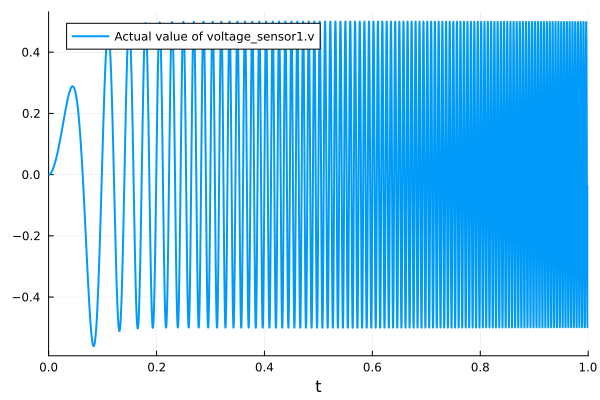
plt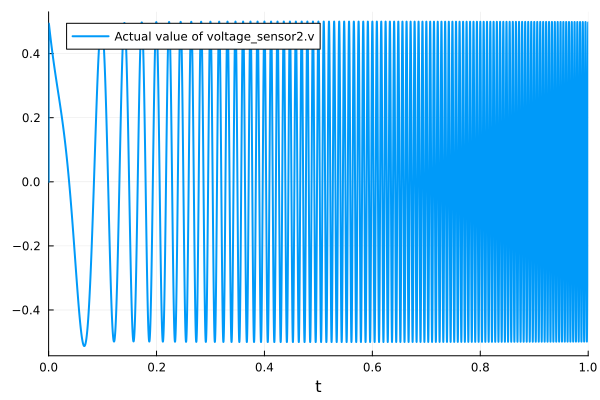
Related
Examples
Experiments
Analyses