Analog.ControlledIdealTwoWaySwitch
This component extends from ConditionalHeatPort
Usage
TranslatedComponents.Analog.ControlledIdealTwoWaySwitch(T=293.15, unitVoltage=1, unitCurrent=1, level=0.5, Ron=1.0e-5, Goff=1.0e-5)
Parameters:
| Name | Description | Units | Default value |
|---|---|---|---|
useHeatPort | – | false | |
T | K | 293.15 | |
unitVoltage | V | 1 | |
unitCurrent | A | 1 | |
level | V | 0.5 | |
Ron | Ω | 0.00001 | |
Goff | S | 0.00001 |
Connectors
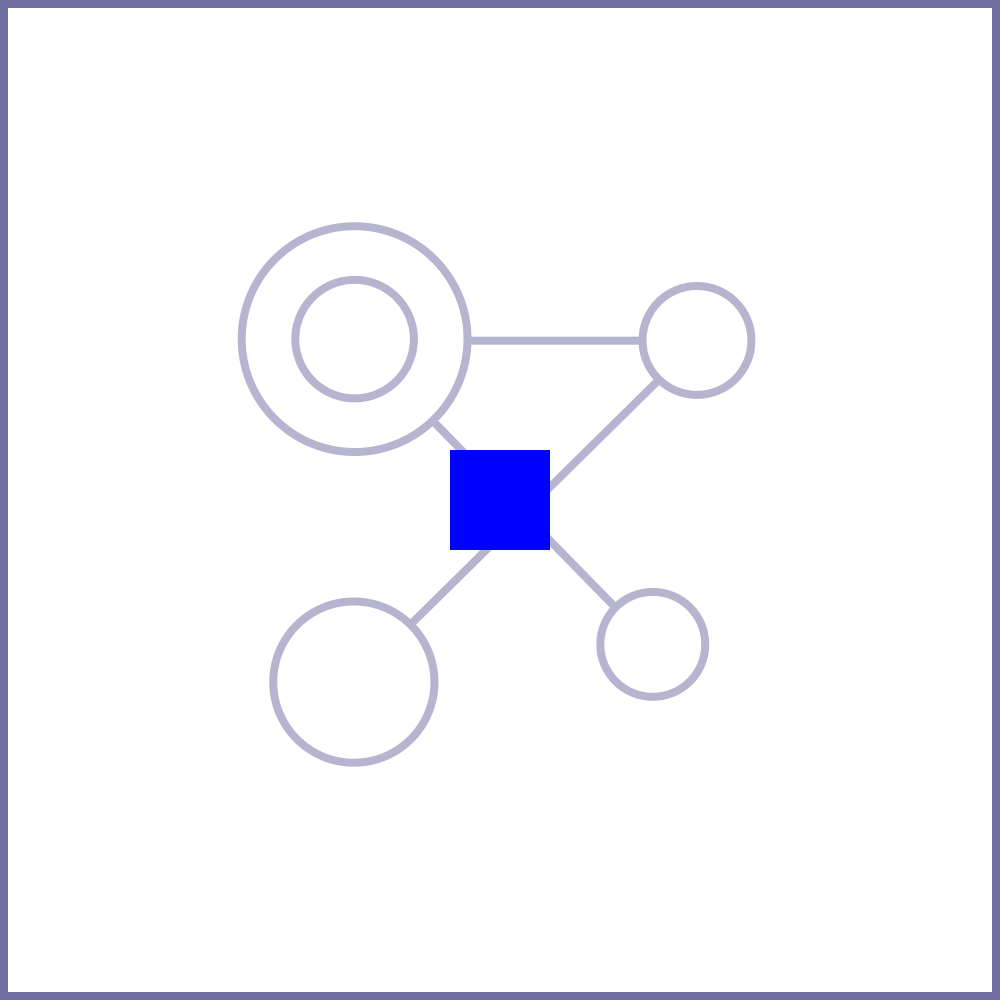
heatPort- (HeatPort)p- This connector represents an electrical pin with voltage and current as the potential and flow variables, respectively. (Pin)n2- This connector represents an electrical pin with voltage and current as the potential and flow variables, respectively. (Pin)n1- This connector represents an electrical pin with voltage and current as the potential and flow variables, respectively. (Pin)control- This connector represents an electrical pin with voltage and current as the potential and flow variables, respectively. (Pin)
Variables
| Name | Description | Units |
|---|---|---|
LossPower | W | |
T_heatPort | K | |
s1 | – | |
s2 | – |
Behavior
using TranslatedComponents #hide
using ModelingToolkit #hide
@variables T #hide
@variables unitVoltage #hide
@variables unitCurrent #hide
@variables level #hide
@variables Ron #hide
@variables Goff #hide
@named sys = TranslatedComponents.Analog.ControlledIdealTwoWaySwitch(T=T, unitVoltage=unitVoltage, unitCurrent=unitCurrent, level=level, Ron=Ron, Goff=Goff) #hide
full_equations(sys) #hide
<< @example-block not executed in draft mode >>Source
component ControlledIdealTwoWaySwitch
  extends ConditionalHeatPort(T = 293.15)
  p = Pin()
  n2 = Pin()
  n1 = Pin()
  control = Pin()
  parameter unitVoltage::Dyad.Voltage = 1
  parameter unitCurrent::Dyad.Current = 1
  # Switch level
  parameter level::Dyad.Voltage = 0.5
  # Closed switch resistance
  parameter Ron::Dyad.Resistance(final min = 0) = 1.0e-5
  # Opened switch conductance
  parameter Goff::Dyad.Conductance(final min = 0) = 1.0e-5
  variable s1::Real
  # Auxiliary variables
  variable s2::Real
relations
  control.i = 0
  0 = p.i + n2.i + n1.i
  p.v - n1.v = s1 * (control.v > level ? unitVoltage : Ron * unitCurrent)
  n1.i = -s1 * (control.v > level ? Goff * unitVoltage : unitCurrent)
  p.v - n2.v = s2 * (control.v > level ? Ron * unitCurrent : unitVoltage)
  n2.i = -s2 * (control.v > level ? unitCurrent : Goff * unitVoltage)
  LossPower = p.i * p.v + n1.i * n1.v + n2.i * n2.v
end
Flattened Source
component ControlledIdealTwoWaySwitch
  heatPort = TranslatedComponents.HeatTransfer.HeatPort() if useHeatPort
  # = true, if heatPort is enabled
  structural parameter useHeatPort::Boolean = false
  # Fixed device temperature if useHeatPort = false
  parameter T::Dyad.Temperature = 293.15
  # Loss power leaving component via heatPort
  variable LossPower::Dyad.Power
  # Temperature of heatPort
  variable T_heatPort::Dyad.Temperature
  p = Pin()
  n2 = Pin()
  n1 = Pin()
  control = Pin()
  parameter unitVoltage::Dyad.Voltage = 1
  parameter unitCurrent::Dyad.Current = 1
  # Switch level
  parameter level::Dyad.Voltage = 0.5
  # Closed switch resistance
  parameter Ron::Dyad.Resistance(final min = 0) = 1.0e-5
  # Opened switch conductance
  parameter Goff::Dyad.Conductance(final min = 0) = 1.0e-5
  variable s1::Real
  # Auxiliary variables
  variable s2::Real
relations
  if !(useHeatPort)
    T_heatPort = T
  else
    initial heatPort.T = T_heatPort
    initial heatPort.Q_flow = -LossPower
  end
  control.i = 0
  0 = p.i + n2.i + n1.i
  p.v - n1.v = s1 * (control.v > level ? unitVoltage : Ron * unitCurrent)
  n1.i = -s1 * (control.v > level ? Goff * unitVoltage : unitCurrent)
  p.v - n2.v = s2 * (control.v > level ? Ron * unitCurrent : unitVoltage)
  n2.i = -s2 * (control.v > level ? unitCurrent : Goff * unitVoltage)
  LossPower = p.i * p.v + n1.i * n1.v + n2.i * n2.v
metadata {}
end
Test Cases
No test cases defined.
Related
Examples
Experiments
Analyses