Choosing an appropriate model
BatteryComponents offers three battery models, each with different levels of complexity. When selecting the best model for your application, consider the trade-offs between accuracy and computational efficiency:
- Doyle-Fuller-Newman (DFN) Model:
- Most complex and detailed representation
- Provides spatial information on both electrode and electrolyte
- Ideal for applications requiring high accuracy and detailed information
- Single-Particle Model with Electrolyte (SPMe):
- Intermediate level of complexity
- Accounts for electrolyte dynamics
- Suitable for applications that need electrolyte behavior without the full spatial detail of the DFN model
- Single-Particle Model (SPM):
- Least complex and most computationally efficient
- Simplified representation of the battery
- Best for applications where basic performance prediction is sufficient
Select the most appropriate model for your application based on your accuracy requirements and available computational resources, keeping in mind this sliding scale of complexity.
Below all three sits a fourth option that leaves the electrochemistry out altogether: the equivalent circuits, selected with family = BatteryModelFamily.EquivalentCircuit() and a ECMTopology. They have a handful of states rather than hundreds and are what battery management systems are usually built on, but their parameters must be identified from measurements of the particular cell and hold only over the conditions they were identified at. They do not predict aging, though ECMDegradation accepts prescribed capacity and resistance health signals.
For the electrochemical models, BatteryElectrodeSelection chooses the electrodes on which SEI growth and loss of active material are active. The equivalent circuit degradation selection is a separate interface and does not enable these mechanisms.
How the models compare during fast charge
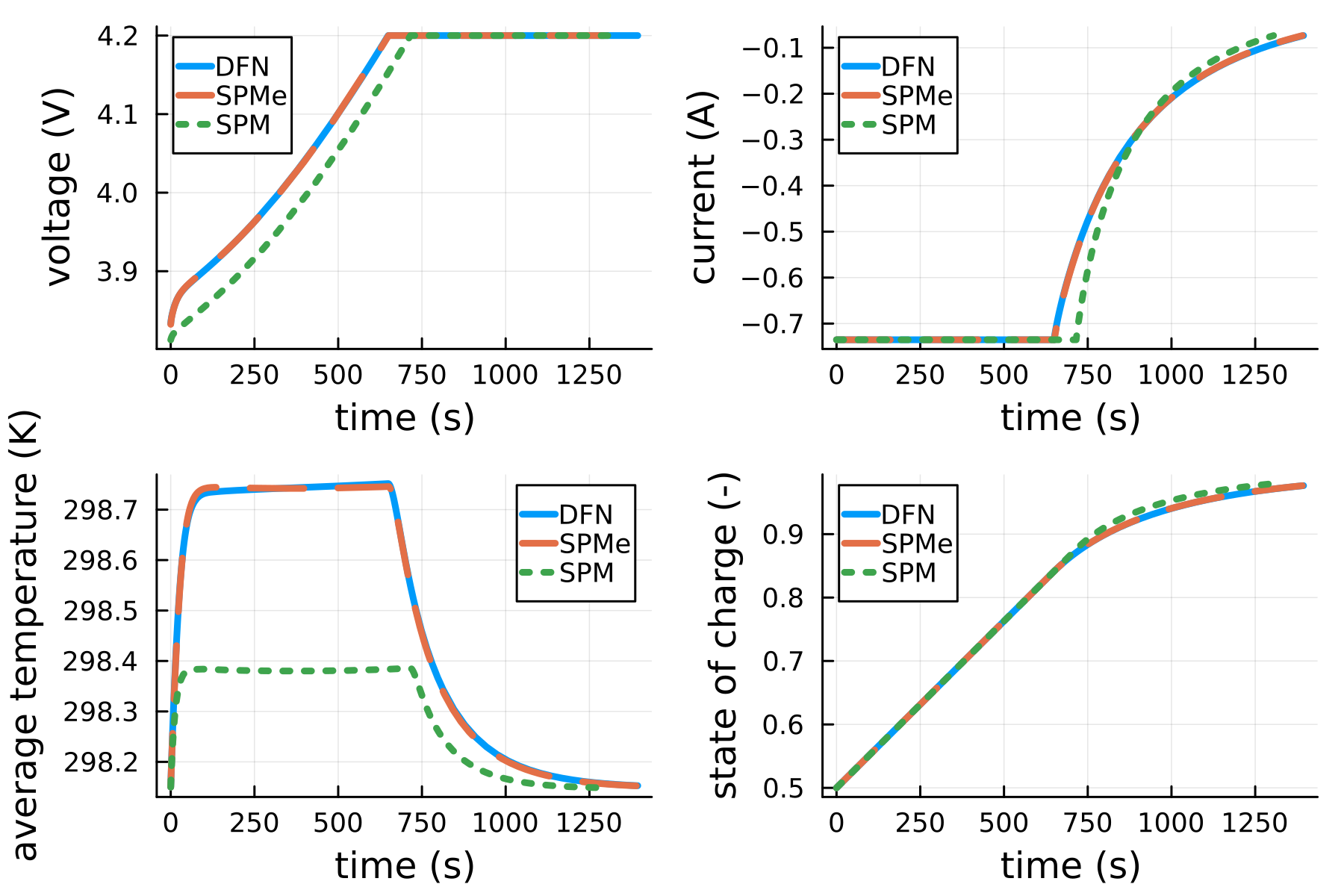
Under a 2C charge to a voltage hold on the NMC parameter set, the SPMe agrees closely with the DFN, and the SPM agrees on voltage and state of charge while missing the electrolyte gradients that set the local overpotential.
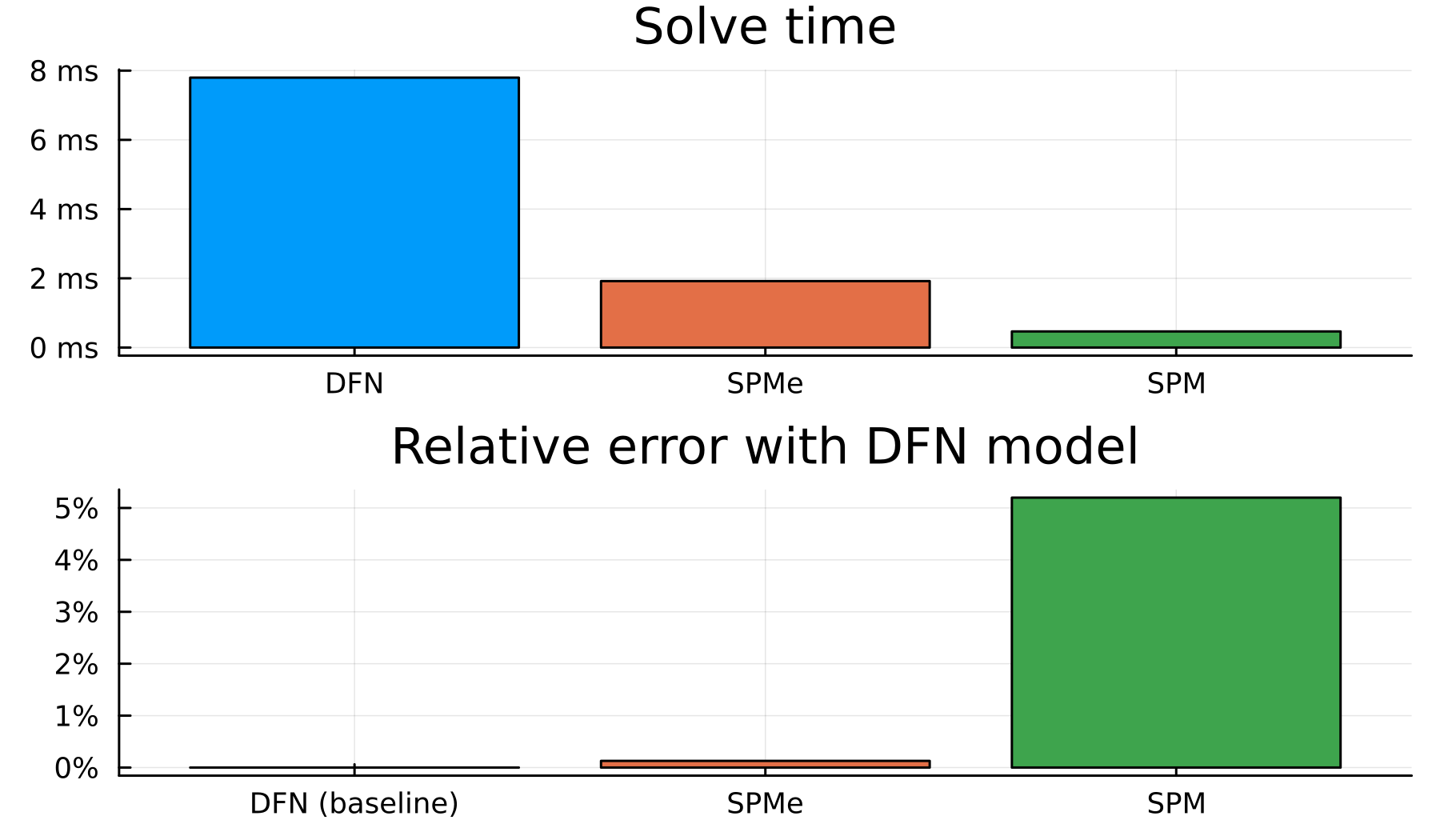
Every application weighs accuracy against cost differently. The bars below are the relative cost of the same simulation in each model.
Doyle-Fuller-Newman (DFN)
The DFN model is a physics-based electrochemical model for lithium-ion batteries that accounts for:
- transport of lithium ions and electrons within the electrolyte and electrode particles
- Intercalation reaction kinetics at the electrode-electrolyte interface
- Conservation of charge in both electrodes
- 1D temperature dynamics in the cell and current collectors
This model captures the spatial variations in concentration, potential, and current density, providing a more accurate representation of the battery behavior under various operating conditions. The DFN model is preferred over the SPM when a higher level of accuracy is required, particularly for predicting battery performance, degradation, and thermal behavior.
To simulate using the DFN, run
  battery = BatteryComponents.ArrayBatteryPack(
    family = BatteryComponents.BatteryModelFamily.DoyleFullerNewman(),
    parameter_set = BatteryComponents.BatteryParameterSet.NMC())
Single-Particle Model with Electrolyte (SPMe)
The SPMe is an intermediate electrochemical model for lithium-ion batteries that incorporates the key features of both the SPM and the DFN model. Like the SPM, the SPMe represents the electrodes as single spherical particles, assuming uniform lithium concentration and potential within each particle. The SPMe accounts for:
- Lithium diffusion within the active materials
- Intercalation reaction kinetics at the electrode-electrolyte interface
- Transport of lithium ions within the electrolyte, similar to the DFN model
- 1D temperature dynamics in the current collectors
Although the SPMe does not capture the full spatial variations in concentration, potential, and current density like the DFN model, it provides a balance between computational efficiency and accuracy. The SPMe is well-suited for applications where the inclusion of electrolyte dynamics is important but computational resources are limited, such as in battery management systems and preliminary design optimization.
To simulate using the SPMe, run
  battery = BatteryComponents.ArrayBatteryPack(
    family = BatteryComponents.BatteryModelFamily.SingleParticleElectrolyte(),
    parameter_set = BatteryComponents.BatteryParameterSet.NMC())
Single-Particle Model (SPM)
The SPM is a simplified electrochemical model for lithium-ion batteries that captures the essential features of battery behavior while reducing computational complexity. The SPM represents the electrodes as single spherical particles, and it assumes uniform lithium concentration and potential within each particle. The model focuses on:
- Lithium diffusion within the active materials
- Intercalation reaction kinetics at the electrode-electrolyte interface
- 1D temperature dynamics in the current collectors
Although the SPM does not account for spatial variations in concentration, potential, and current density as the DFN model does, it is computationally more efficient and is well-suited for applications where a reasonable trade-off between accuracy and computational cost is desired, such as real-time control and optimization tasks.
To simulate using the SPM, run
  battery = BatteryComponents.ArrayBatteryPack(
    family = BatteryComponents.BatteryModelFamily.SingleParticle(),
    parameter_set = BatteryComponents.BatteryParameterSet.NMC())